
A reactor handling 10% hydrochloric acid at 70°C will destroy 316L stainless steel in weeks. Move the same duty into a nickel-molybdenum alloy and the corrosion rate drops to a fraction of a millimetre per year. That gap explains why process engineers specify Hastelloy where stainless steel cannot survive the chemistry.
Hastelloy names a family of nickel-based alloys built around molybdenum, chromium and tungsten. Three grades dominate procurement: Hastelloy C276 (UNS N10276), Hastelloy C22 (UNS N06022) and Hastelloy B2 (UNS N10665). Fabricators order them as Hastelloy Sheets for lining and ducting, as Hastelloy Plates for vessel shells and tube sheets, and as Hastelloy Coils for continuous forming or slitting.
Grade selection is not interchangeable. The acid in the line, its concentration, operating temperature, chloride load and the governing specification together decide which alloy belongs in the drawing. Nandishwar Steel, supplying ferrous and non-ferrous metal products from Maharashtra since 1980, works through that question with buyers before a purchase order is raised. Browse the full range of Hastelloy sheets, plates and coils to match a form and grade to your project.
Hastelloy Grades and Specifications
Hastelloy C276 carries roughly 57% nickel with 15 to 17% molybdenum, 14.5 to 16.5% chromium and 3 to 4.5% tungsten. Low carbon and silicon limit carbide precipitation in weld heat-affected zones, so the alloy holds its corrosion performance as welded, in both oxidising and reducing media.
Where oxidising duty dominates, Hastelloy C22 performs better. Its 20 to 22.5% chromium gives stronger resistance in nitric acid, ferric and cupric chloride solutions and mixed acid systems. Fabricators also favour C22 for weld overlay and dissimilar-metal joints.
Hastelloy B2 takes a different route. With 26 to 30% molybdenum and chromium below 1%, it resists hydrochloric acid across the full concentration curve and tolerates sulphuric and phosphoric acid in reducing conditions. Introduce nitric acid or ferric ions, and the same alloy corrodes rapidly.
| Property | Hastelloy C276 (N10276) | Hastelloy C22 (N06022) | Hastelloy B2 (N10665) |
| Alloy system | Ni-Cr-Mo-W | Ni-Cr-Mo-W | Ni-Mo |
| Nickel | ~57% balance | ~56% balance | ~69% balance |
| Chromium | 14.5 to 16.5% | 20.0 to 22.5% | 1.0% max |
| Molybdenum | 15.0 to 17.0% | 12.5 to 14.5% | 26.0 to 30.0% |
| Tungsten | 3.0 to 4.5% | 2.5 to 3.5% | Not specified |
| Tensile strength, min | 690 MPa (100 ksi) | 690 MPa (100 ksi) | 760 MPa (110 ksi) |
| Yield strength, min | 283 MPa (41 ksi) | 310 MPa (45 ksi) | 350 MPa (51 ksi) |
| Elongation, min | 40% | 45% | 40% |
| Plate and sheet standard | ASTM B575 | ASTM B575 | ASTM B333 |
| Strongest in | Mixed oxidising and reducing acids, wet chlorine, chlorides | Oxidising acids, nitric, ferric chloride | Hydrochloric acid, reducing acids |
| Weak point | Hot concentrated HCl above 70°C | Hot pure HCl service | Any oxidising contaminant |
Confirm composition and property limits against the specification edition named in your purchase order, since values differ by form and thickness band. Grade pages cover each option separately: Hastelloy C276 sheets and plates and Hastelloy C22 sheets and plates.
Hastelloy Sheets, Plates and Coils
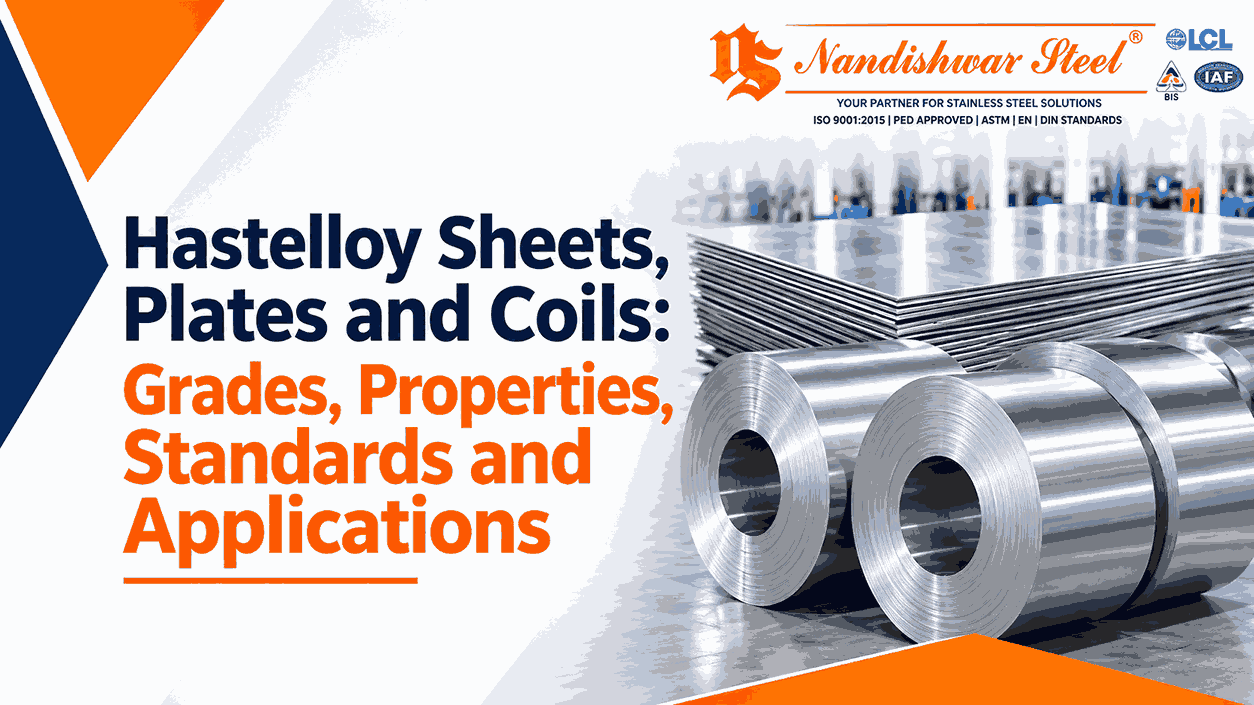
Thickness separates the three forms. Sheet covers material up to 4.75 mm, plate starts above that and runs into the 50 mm range for vessel work, and coil arrives as continuous strip wound for slitting, roll forming or progressive press work.
Choose the form from how the part gets made. A 2 mm sheet suits tank lining, ducting, scrubber internals and bellows, where a fabricator cuts blanks and welds them into position. Plate goes into shells, heads, tube sheets and flanges carrying pressure after forming and inspection.
Coil earns its place on volume. When a job calls for 400 identical formed components, slitting from coil cuts scrap and handling time against blanking the same parts from individual sheets. Mill coil widths commonly run 1000 mm to 1500 mm, with 1000 x 2000 mm and 1250 x 2500 mm among the more frequently stocked sheet sizes. Dimensions, finish, edge condition and minimum order quantity vary by mill and grade, so confirm each before issuing the order.
Chemical Composition and Mechanical Properties
Each alloying element does a defined job. Nickel forms the austenitic matrix and carries resistance to chloride stress corrosion cracking. Molybdenum drives resistance to pitting, crevice attack and reducing acids, which is why B2 pushes molybdenum to 30%. Chromium builds the passive film for oxidising service, and tungsten reinforces localised corrosion resistance in C276 and C22.
Mechanical values sit in a narrower band than many buyers expect. Solution-annealed C276 plate meets 690 MPa tensile, 283 MPa yield and 40% elongation as minimums. C22 matches that tensile figure, reaches 310 MPa yield and delivers 45% elongation. B2 runs harder at 760 MPa tensile and 350 MPa yield while holding 40% elongation.
Hardness and elevated-temperature allowable stresses shift with form, thickness and heat treatment, so cold-worked coil shows higher strength and lower elongation than annealed plate in the same grade. Verify every design value against the governing standard and the mill test certificate for the heat you receive.
Corrosion Resistance and Chemical Compatibility
Concentration and temperature decide the outcome more than the alloy name does. C276 resists wet chlorine gas, hypochlorite, chlorine dioxide, seawater and sulphuric acid across wide concentration ranges, and handles the ferric and cupric chlorides that attack molybdenum-lean grades. Above roughly 70°C in concentrated hydrochloric acid, its corrosion rate climbs.
C22 pulls ahead wherever an oxidiser is present. Nitric acid service, mixed acid pickling lines and flue gas desulphurisation systems carrying oxidised chlorides all suit the higher-chromium grade, which also resists intergranular attack as welded.
B2 covers the opposite corner of the map. Pure hydrochloric acid at all concentrations, hydrogen chloride gas and acetic acid production fall within its range, provided the stream stays free of oxidisers. A few hundred ppm of ferric ion can change its corrosion rate by an order of magnitude. Treating the three grades as substitutes creates failures, so run the actual stream analysis, trace contaminants and upset conditions included, against published corrosion data before the grade enters the specification.
Hastelloy Industrial Applications
- Chemical processing: Reactors, acid storage tanks, mixing vessels and piping handling hydrochloric, sulphuric and phosphoric acid streams.
- Pollution control: Flue gas desulphurisation absorbers, scrubbers, ducting and stack liners exposed to acidic chloride condensate.
- Pharmaceutical manufacturing: Process vessels, agitators, filter housings and transfer lines requiring contamination-free surfaces and repeated acid cleaning cycles.
- Power generation: Heat exchanger tube sheets, condenser components and waste heat recovery parts in sour or chloride-bearing cooling water.
- Pulp, paper and sugar: Bleach plant washers, digesters, evaporator bodies and chlorine dioxide handling equipment under constant chemical attack.
- Oil and gas: Sour service separators, wellhead components and offshore piping exposed to hydrogen sulphide, chlorides and elevated temperature.
Match the grade to design life. A vessel built for 20 years of service justifies the material cost when the alternative needs relining every third year.
Hastelloy vs Other Nickel Alloys and Stainless Steel
Austenitic grades such as 304L and 316L cost a fraction of nickel alloy pricing, but their 2 to 3% molybdenum ceiling limits them in chloride and reducing acid service. Duplex and super duplex extend that range at moderate cost. Past a certain chloride concentration and temperature, both families reach their limit.
Among nickel alloys the choice widens. Alloy 400 suits hydrofluoric acid and seawater, and Alloy 625 brings high-temperature strength that C276 does not match. Hastelloy grades hold the wet, chloride-heavy middle ground where pitting and crevice attack govern design. Fabrication cost matters too, since these alloys work-harden faster and need qualified procedures with matching filler. Compare the alternatives across the nickel alloy sheets and plates range before settling on a grade.
Hastelloy Standards and Product Specifications
Name the specification in the enquiry. ASTM B575 covers low-carbon nickel-chromium-molybdenum plate, sheet and strip, governing both C276 and C22 in flat-rolled form. ASTM B333 applies to B2, since the Ni-Mo system sits under a separate standard. ASME SB-575 and SB-333 serve the same grades for Section II pressure vessel work.
One specification does not cover every Hastelloy product. Bar, forgings, pipe, tube and fittings each carry their own standards, and a certificate issued to a bar specification does not qualify plate. Spell out grade and UNS number, form, thickness and width, tolerance table, finish, heat treatment condition and any supplementary testing on the order document.
Fabrication, Welding and Processing
Cutting demands the right process. Plasma, laser and waterjet all work here, while abrasive wheel cutting risks embedding iron particles that later initiate pitting. Keep carbon steel tooling and grinding media away from nickel alloy stock, and clean every surface before welding.
Welding runs on GTAW, GMAW and SMAW with matching filler: ERNiCrMo-4 for C276, ERNiCrMo-10 for C22, ERNiMo-7 for B2. Control interpass temperature and limit heat input, since slow cooling through the sensitisation range promotes secondary phase precipitation at grain boundaries. Qualify the procedure to ASME Section IX first.
Forming behaves predictably once you account for work hardening. These alloys need higher forming loads than stainless steel and an intermediate anneal on severe draws. For machined components, review the Hastelloy round bars range alongside flat products.
Quality Testing, Inspection and Certification
Traceability starts at the heat number. Each plate, sheet or coil should carry a heat identification tying back to a mill test certificate recording chemical analysis by element, tensile and yield values, elongation and the heat treatment condition.
Testing scope follows the purchase specification. EN 10204 3.1 certification covers most commercial orders, while 3.2 adds a third-party witness. ASTM G28 Method A testing assesses intergranular attack in C276 and C22, ultrasonic examination screens plate for internal discontinuities, and XRF or OES identification at receipt should match the certificate before material enters the shop.
Hastelloy Supplier, Exporter and Procurement
Evaluate a Hastelloy Supplier on documentation discipline as much as on price. Ask whether the mill test certificate accompanies every item, whether heat numbers stay legible after cutting, and whether the quoted thickness is genuinely available.
Include these details in the enquiry to a Hastelloy Exporter or stockist:
- Grade and UNS designation, for example C276 / N10276
- Product form: sheet, plate or coil
- Thickness, width and length, with tolerance class
- Quantity in kilograms or pieces
- Applicable specification and edition, such as ASTM B575
- Surface finish and edge condition
- Certification level and any third-party inspection requirement
- Delivery location, target date and packing instructions
Nandishwar Steel supplies sheets, plates, pipes, tubes, rods, bars, strips, circles, channels, angles and fittings to customers in oil and gas, petrochemical, chemical, pharmaceutical, power generation, pulp and paper, sugar, brewing and general engineering. Our team reviews grade suitability, specifications, and dimensions before quoting. View the complete Nandishwar Steel product range to scope your requirement.
Send your grade, form, dimensions, quantity and applicable specification for a firm quotation.
Frequently Asked Questions
What is the difference between Hastelloy C276, C22 and B2?
C276 covers mixed oxidising and reducing media with 16% molybdenum and 16% chromium. C22 raises chromium to 22% for oxidising acids. B2 carries 28% molybdenum with almost no chromium, suiting hydrochloric acid service only.
What are Hastelloy sheets, plates and coils used for?
Sheets line tanks, scrubbers and ducting. Plates form pressure vessel shells, heads and tube sheets. Coils feed roll forming and slitting lines for repeat components in chemical, pharmaceutical and pollution control equipment.
Which ASTM standards apply to Hastelloy sheets and plates?
ASTM B575 governs C276 and C22 plate, sheet, and strip. ASTM B333 covers B2 in the same forms. Pressure vessel work uses the ASME SB equivalents. Bar, pipe and fittings follow separate specifications.
How do you select the right Hastelloy grade for corrosive environments?
Start with the full stream analysis: acid type, concentration, temperature, chloride level, and trace oxidisers. Compare each against published corrosion rate data. Factor in upset and shutdown chemistry, then confirm the grade with the fabricator.
What documents should buyers request when purchasing Hastelloy products?
Request the EN 10204 3.1 or 3.2 mill test certificate with heat number, chemical analysis and mechanical test results. Add ASTM G28 corrosion test reports, ultrasonic examination records, and dimensional inspection reports where the specification calls for them.
What factors affect Hastelloy sheet, plate and coil prices?
Nickel and molybdenum exchange prices move the base cost, so B2 at 28% molybdenum prices above C276. Thickness, width, quantity, surface finish, certification level and mill lead time adjust the final figure.