
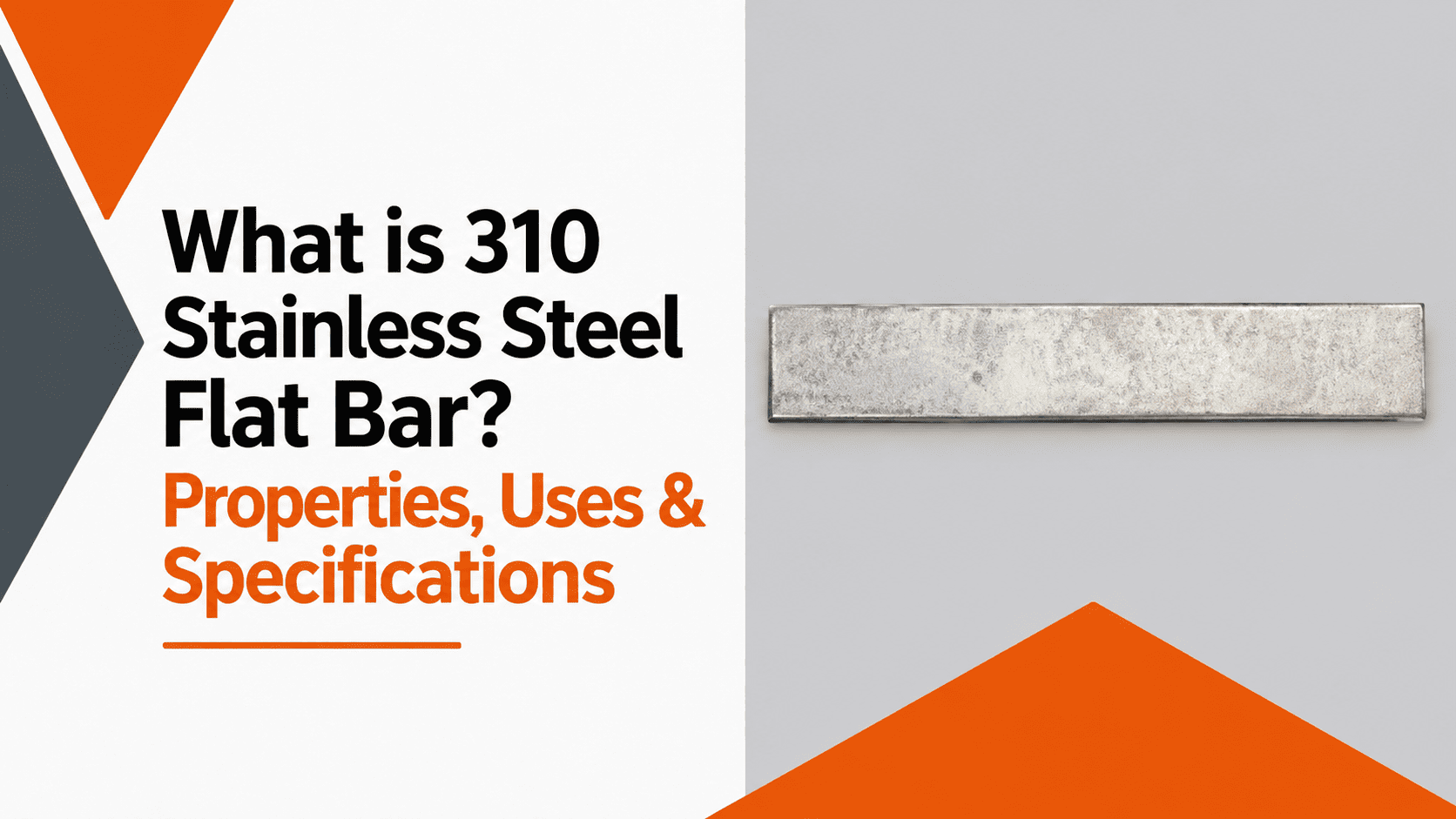
310 stainless steel flat bar is a high-alloy austenitic product built for service where heat and oxidation govern material choice. Buyers comparing 310 SS flat bar exporters begin with grade confirmation, then move to dimensions and certification. This article covers its properties, applicable specifications, industrial uses, and the selection factors that matter before a purchase order is raised.
What Is a 310 Stainless Steel Flat Bar?
Stainless Steel 310 is an austenitic grade alloyed with 24 to 26% chromium and 19 to 22% nickel. A flat bar is a rectangular solid section supplied in set widths and thicknesses, used for supports, brackets, frames, and machined components. Fabricators cut, drill, and weld it into structures that sit inside heated equipment. Bar products in this grade fall under specifications such as ASTM A276 or ASTM A479. The chromium and nickel content suits it for selected high-temperature applications.
Key Properties of 310 Stainless Steel Flat Bar
Four characteristics explain why specifiers select this grade for hot service.
High-Temperature Resistance
310 flat bar holds its structural form in continuously heated equipment, including furnace internals and retort fittings. Service limits depend on atmosphere and cycle pattern, so verify them per application.
Oxidation Resistance
Chromium in the alloy forms a tight surface oxide that slows scaling at raised temperatures. Furnace hearths, muffles, and thermal-processing fixtures rely on that film during long heating runs.
Mechanical Strength
Annealed bar to ASTM A276 carries 515 MPa minimum tensile strength and 205 MPa yield. Strength drops as temperature rises, so design around the service condition, not room-temperature figures alone.
Thermal Stability
The grade resists structural change through prolonged heat exposure, which matters in equipment running for weeks without shutdown. Allow for thermal expansion at fixings and welded joints.
310 Stainless Steel Flat Bar Specifications
Confirm each point below at the enquiry stage. Bar ordered against an incomplete specification reaches the shop floor with gaps that stall fabrication.
| Specification | What to Check |
| Grade | 310 or 310S |
| Product Form | Flat Bar |
| Dimensions | Width, thickness and length |
| Standard | Applicable ASTM/ASME or project specification |
| Finish | As required for fabrication or application |
| Documentation | MTC and traceability requirements |
Manufacturing conditions, composition limits, and mechanical test requirements belong on the purchase order as well.
Where Are 310 Stainless Steel Flat Bars Used?
Across four equipment groups, flat bar in this grade serves as a fabricated structure rather than a pressure-containing part. Each group loads the material differently.
Furnace and Heat-Treatment Equipment
Furnace builders use 310 flat bar for hearth supports, door frames, charge car members, and grate assemblies. Oxidation resistance keeps these fabricated members serviceable through repeated heating cycles.
Thermal Processing Systems
Industrial heating lines, calciners, and dryers carry fabricated bar sections inside their hot zones. Stability under sustained temperature keeps alignment and clearances within tolerance across long production runs.
Petrochemical and Chemical Processing
Selected process units take 310 bar for internal supports and hangers in hot service. Chemical compatibility with the process medium needs separate assessment because heat resistance doesn’t cover corrosion.
Power and Industrial Equipment
Boiler houses, incinerators, and kiln structures use the bar for brackets, stiffeners, and anchor components near heat sources. Section size follows the mechanical load, not the temperature alone.
310 vs 310S Stainless Steel Flat Bar
310S carries the same chromium and nickel base as 310, with carbon capped at 0.08% against 0.25%. Lower carbon limits carbide precipitation during welding, though neither grade outranks the other.
| Factor | Stainless Steel 310 | Stainless Steel 310S |
| Stainless Steel Type | Austenitic | Austenitic |
| Carbon Content | Higher | Lower |
| High-Temperature Use | Suitable for demanding applications | Suitable for demanding applications |
| Welding Considerations | Application-dependent | Lower carbon can support weldability |
| Selection | Service requirement dependent | Fabrication and service dependent |
How to Select the Right 310 Stainless Steel Flat Bar
Nine factors decide the right bar for a job, and operating temperature on its own settles none of them.
- Operating temperature: record peak and steady-state values, because each drives a different material check.
- Heat exposure pattern: continuous and cyclic duty age the bar differently, so state which applies.
- Service environment: describe the atmosphere, including sulphur, chlorides, or carburising gases around the component.
- Width and thickness: fix section size against load and fabrication method before requesting prices.
- Mechanical loading: state static and dynamic loads at temperature, not room-temperature equivalents.
- Fabrication and welding: confirm whether welding follows, since that points towards 310S on welded assemblies.
- Surface finish: specify hot-rolled, cold-drawn, or ground to suit the downstream process.
- Applicable specifications: quote ASTM A276, ASTM A479, or the project specification governing the order.
- Testing and certification: list required tests, including composition, tensile, and intergranular corrosion checks.
Quality Checks Before Buying
Material problems surface at fabrication, long after the invoice clears. Nandishwar Steel supplies stainless, carbon, and alloy steel products from Maharashtra. Work through these checks before placing an order with 310 SS flat bar exporters.
- Verify the grade marking against the order
- Confirm whether the build needs 310 or 310S
- Check width, thickness, and length
- Review the governing standard and revision
- Request Material Test Certificates before dispatch
- Match composition limits to the specification
- Check mechanical results where the design requires
- Verify heat number traceability on critical projects
Conclusion
310 stainless steel flat bar is a hot-service, high-chromium, high-nickel austenitic flat bar. It is suitable for furnace and thermal-processing fabrication due to its oxidation resistance, thermal stability and annealed strength. Before purchase, verify the grade, dimensions, governing standard, certification and operating conditions.