
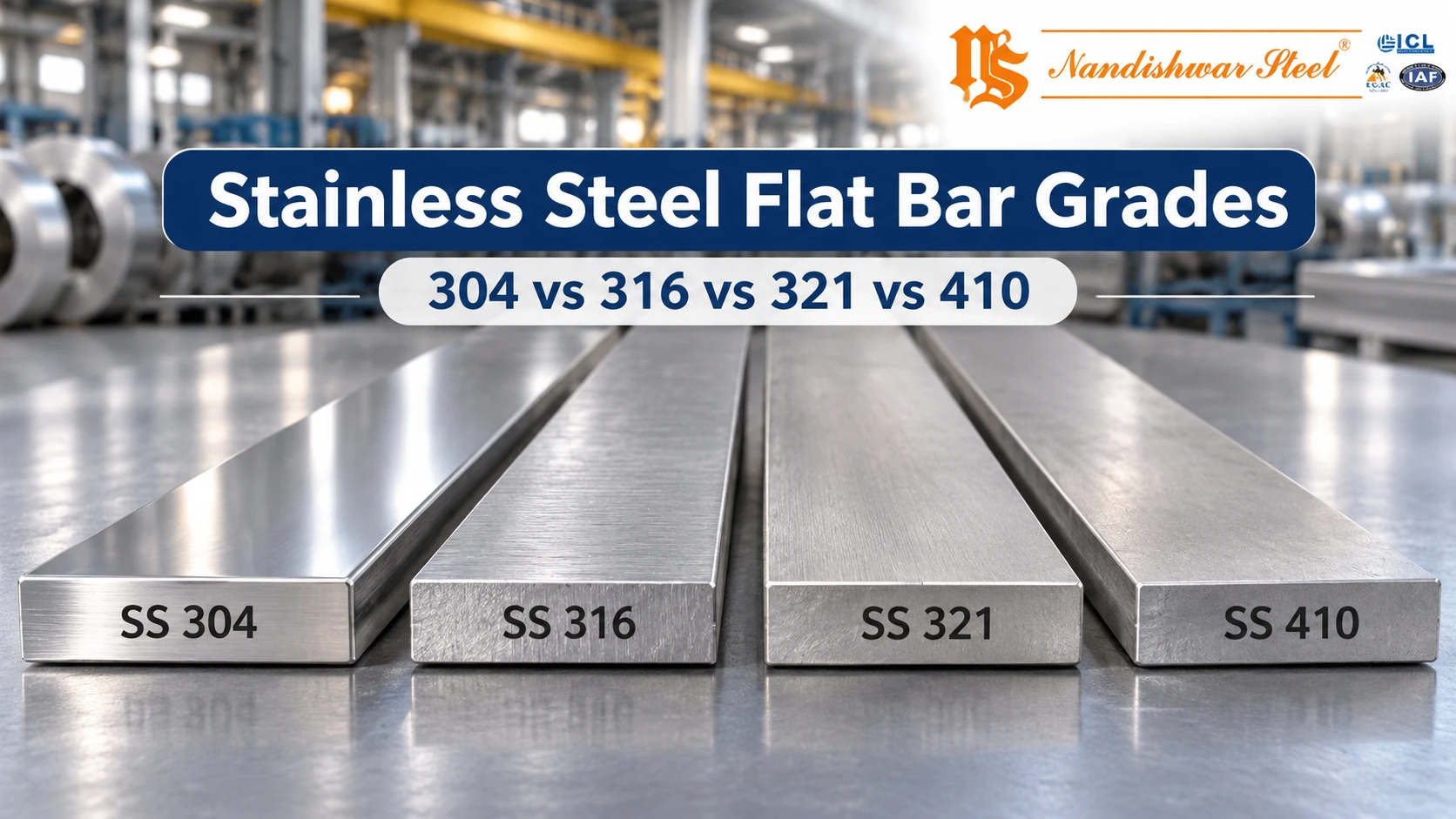
Stainless steel flat bars are used in fabrication, construction, engineering, and industrial applications. Grade selection is dependent on the corrosion resistance, service condition, temperature and strength.
What Is a Stainless Steel Flat Bar?
A stainless steel flat bar is a wide, thin rectangular section with square edges. Fabricators weld it into brackets, frames, structural supports, and base plates. Its 10.5% minimum chromium forms a self-healing oxide film, so it outlasts carbon steel in corrosive service. Grades differ in performance.
Stainless Steel Flat Bar Grades: 304, 316, 321 & 410
Stainless Steel 304 / 304L Flat Bars
304/304L stainless steel flat bars carry 18% chromium and 8% nickel, forming and welding easily. Low-carbon 304L suits welded fabrication, architecture, and food equipment.
Stainless Steel 316 / 316L Flat Bars
316/316L stainless steel flat bars add 2 to 3% molybdenum, resisting chloride pitting better than 304. Low-carbon 316L suits welded marine, chemical, and process equipment.
Stainless Steel 321 / 321H Flat Bars
321/321H stainless steel flat bars use titanium stabilization to resist carbide precipitation at high heat. Higher-carbon 321H holds strength above 500°C in process equipment.
Stainless Steel 410 Flat Bars
410 stainless steel flat bars are martensitic and harden with heat treatment. Corrosion resistance trails austenitic grades, so 410 suits mechanical parts and engineering components.
Other Stainless Steel Flat Bar Grades to Consider
Stainless Steel 310 / 310S Flats
310/310S stainless steel flats carry 25% chromium and 20% nickel, resisting oxidation in furnaces, kilns, and other heat-exposed industrial settings.
Stainless Steel 317 / 317L Flats
317/317L stainless steel flats contain 3 to 4% molybdenum, giving higher corrosion resistance than 316 in chemical and process equipment.
Stainless Steel 347 / 347H Flats
347/347H stainless steel flats use niobium stabilization, which protects welded joints from intergranular attack and holds strength in elevated-temperature service.
304 vs 316 vs 321 vs 410 Stainless Steel Flat Bars
- Family: 304, 316, and 321 are austenitic; 410 is martensitic.
- Corrosion resistance: 316 leads, 304 and 321 follow, 410 trails.
- Temperature: 321 performs best under sustained heat; 410 suits moderate temperatures.
- Strength and hardness: 410 hardens with heat treatment; austenitic grades stay softer.
- Weldability: 304L, 316L, and 321 weld readily; 410 needs preheating.
This table compares type, key advantage, and typical application.
| Grade | Type | Key Advantage | Typical Application |
|---|---|---|---|
| 304/304L | Austenitic | General corrosion resistance | Fabrication & general industry |
| 316/316L | Austenitic | Enhanced corrosion resistance | Marine & chemical |
| 321/321H | Austenitic | High-temperature stability | Heat & process equipment |
| 410 | Martensitic | Strength and hardness | Mechanical components |
How to Choose the Right Stainless Steel Flat Bar Grade
Chlorides from seawater or road salt point to 316; dry indoor service allows 304. Set operating temperature next, since sustained heat above 500°C favors 321 or 310. Match strength, hardness, welding, and chemical, moisture, and heat exposures to use. Read specifications before purchasing.
Applications of Stainless Steel Flat Bars by Grade
- 304/304L flat bars serve general fabrication, food processing plants, architectural trim, and industrial frameworks needing moderate corrosion resistance.
- Flat bars 316/316L are used for coastal installations in salt air exposure, chemical lines, pharmaceutical plants, and marine structures.
- 321/321H flat bars go into heat exchangers, high-temperature equipment, and welded process systems cycling through hot service.
- Type 410 material flat bar is used for mechanical parts and engineering assemblies where a higher hardness than the austenitic grades is needed.
- Choose 310 for furnace heat, 317 for aggressive chemicals, and 347 for welded high-temperature assemblies.
Standards and Quality Considerations
There are specifications defining stainless steel bars, and they include ASTM A276 and ASME SA-276. Heat number for traceability and identification (important because 304 and 316 are visually similar). Check surface finish and dimensions. Ask for Material Test Certificates (MTCs) on all industrial orders, and inspect for grade, dimensions, and certification prior to purchase.
Conclusion
304 for corrosion resistance, 316 for chlorides, 321 for heat, and 410 for toughness. Various grades are suited for different applications; weigh your specific service environment vs. requirements for corrosion resistance, heat, strength, and ease of fabrication. Nandishwar Steel supplies these stainless steel flat bars, plus 310, 317, and 347, on our Stainless Steel Flats page.