
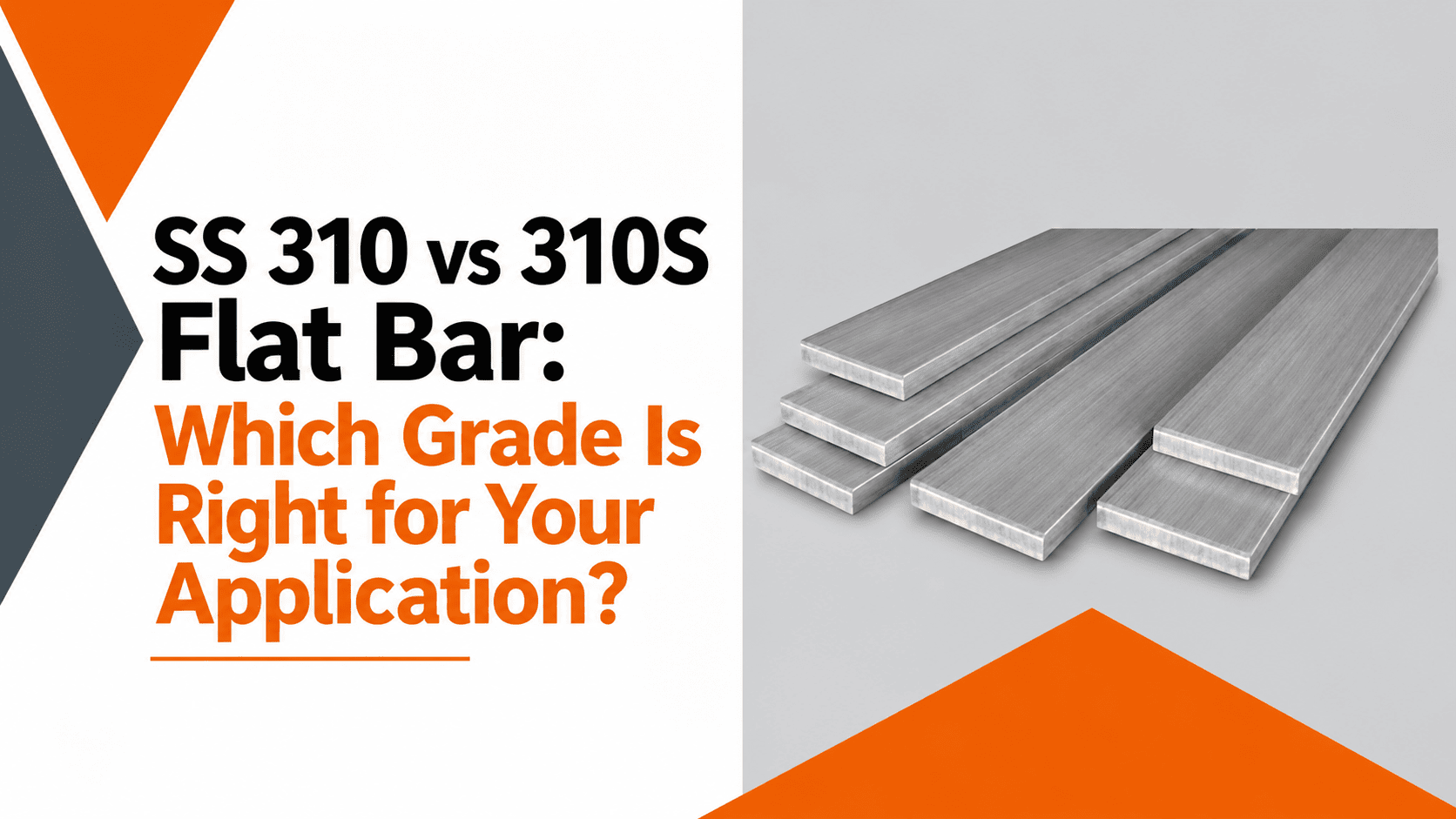
Carbon content separates SS 310 from SS 310S, and that single difference decides which grade suits your application. Both are heat-resistant austenitic stainless steels with high chromium and nickel levels, so both resist oxidation and scaling at elevated temperatures. The lower carbon in 310S reduces the risk of sensitisation during welding, while 310 is used in applications where higher carbon is specified. Neither grade outperforms the other across every condition. Selecting a 310 SS flat bar therefore depends on service temperature, welding needs and the material standard your project follows.
What Is SS 310 Flat Bar?
SS 310 is an austenitic grade containing 24 to 26% chromium and 19 to 22% nickel. That chromium level forms a stable oxide layer resists scaling in continuous service up to 1150°C. Mills supply the grade as a stainless steel flat bar across a range of thicknesses and widths. Furnace parts, radiant tubes, kiln linings, and heat-treatment fixtures use it. Carbon appears higher than in 310S, supporting strength retention at sustained temperature.
What Is SS 310S Flat Bar?
The 310S designation covers the low-carbon version of 310, with carbon capped at 0.08% against 0.25% for the standard grade. Lower carbon limits chromium carbide precipitation at grain boundaries during welding and during long exposure in the 425°C to 870°C band. Fabricators choose it for welded furnace assemblies, annealing boxes and structural supports inside heat-treatment plants. Oxidation resistance matches that of 310, since the chromium and nickel ranges remain identical in both grades.
SS 310 vs 310S Flat Bar: Key Differences
Four factors separate the two grades in practice: carbon level, welding behaviour, performance at temperature, and the applications each one suits. The table below sets them side by side.
| Comparison Factor | SS 310 Flat Bar | SS 310S Flat Bar |
| Carbon content | Higher than 310S | Lower-carbon version |
| Oxidation resistance | Good at elevated temperatures | Good at elevated temperatures |
| Welding considerations | May require closer attention to sensitisation | Often preferred where reduced sensitisation risk is needed |
| Typical selection | Suitable for specified heat-resistant applications | Suitable for welded or heat-exposed components where low carbon is beneficial |
Both grades hold strong oxidation resistance at elevated temperatures. Engineers choose 310S for welded components, where reduced sensitisation risk protects the heat-affected zone against intergranular attack.
Applications of SS 310 and 310S Flat Bars
Both grades serve high-temperature equipment, though selection follows the fabrication route. Welded assemblies lean towards 310S, while machined and bolted parts use 310.
SS 310 Flat Bar Applications
Furnace parts, hearth plates, and heat-treatment fixtures account for most demand. The grade also supports burner components, kiln hardware, and industrial fittings exposed to repeated oxidation at temperature.
SS 310S Flat Bar Applications
Welded furnace assemblies, radiant tube supports, and annealing equipment rely on the low-carbon grade. Petrochemical heaters use it where post-weld sensitisation would otherwise shorten their service life.
How to Choose Between SS 310 and 310S Flat Bar
Start with the operating temperature and the atmosphere the bar will face, since sulphur-bearing or reducing environments change performance. Welding comes next: if the component carries welds and sits in the 425°C to 870°C range, the low-carbon grade reduces intergranular corrosion risk. Confirm mechanical requirements, finished dimensions, and the governing standard, which for flat bar is ASTM A276 or ASTM A479. Project specifications decide the final call, because neither grade performs better across every condition.
Factors to Consider When Buying 310 SS Flat Bar
Procurement decisions on 310 SS flat bar extend past grade selection. Five checks protect the project from rework, inspection rejection, and avoidable delays on site.
- Dimensions and tolerances: Confirm thickness, width, length, and tolerance class.
- Grade and standard: Match the specification on the drawing.
- Test certificates: Request mill certificates with heat numbers for traceability.
- Surface finish: Specify what the fabrication route requires.
- Supplier capability: Verify stock depth and dispatch timelines.
Conclusion
Carbon content remains the dividing line. SS 310 carries up to 0.25% carbon and suits heat-resistant applications where welding plays a limited role, while 310S holds carbon at 0.08% and fits welded assemblies at sustained temperature. Nandishwar Steel supplies both grades in standard and custom sizes. Share your drawing and specification for a quotation on your 310 SS flat bar.