
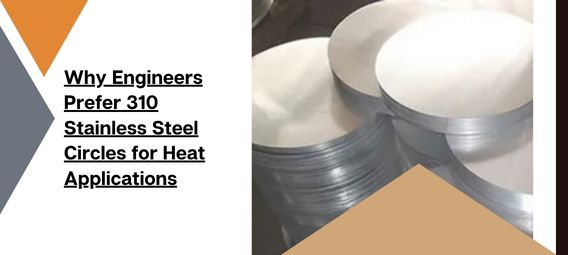
Stainless steel circles are flat, disc-shaped blanks cut from SS sheets. Fabricators use them as stock for flanges, discs, base components, and other machined parts. Most standard grades work fine in normal conditions. The problem starts when temperatures go above 800°C and stay there for extended periods. That’s where many grades begin to scale, warp, or oxidize rapidly.
The need for heat-stable materials is increasing, especially in the petrochemical, cement and power generation industries. These industries need materials that don’t degrade after six months of continuous heat exposure. 310 stainless steel circles have become a go-to choice specifically because of how they handle high-temperature environments. Not because of marketing. Because the alloy composition actually holds up where others fail.
What Makes 310 SS Circles Suitable for Heat Applications?
The chemistry is the main reason. 310 grade contains roughly 24 to 26% chromium and 19 to 22% nickel. That’s significantly higher than what you get in 304 or 316. The high chromium level builds a protective oxide layer on the surface that doesn’t break down easily under heat. Nickel stabilises the austenitic structure and improves ductility at elevated temperatures.
The 310 stainless steel properties that matter most in heat applications are oxidation resistance, scaling resistance, and thermal stability. The material doesn’t form heavy oxide buildup even when repeatedly exposed to temperatures near 1100°C. Mechanical strength doesn’t drop drastically under heat the way it does in lower-alloy grades. There’s no dramatic structural failure in most thermal processing conditions. The material just keeps performing.
It’s also worth noting that 310 handles cyclic heat reasonably well. Applications where equipment heats up and cools down repeatedly are harder on materials than sustained heat. 310 SS circles hold their shape and surface condition through those cycles better than most alternatives at a comparable price point.
Key Advantages of 310 SS Circles in Industrial Applications
- High-temperature resistance: Remains in service up to 1100°C with no appreciable oxidation. Most other austenitic grades fail well before this point.
- Corrosion and oxidation resistance: The chromium-rich oxide layer is stable in oxidizing atmospheres and moderate sulfur environments. Not unlimited resistance but reliable for most industrial conditions.
- Long service life: Longer-lasting components. Replacement frequency is less than in the same heat environment for standard grades. That’s the practical advantage.
- Fabrication and weldability: 310 SS circles can be formed, machined, and welded without excessive difficulty. Post-weld cracking is manageable with proper technique.
- Dimensional stability under thermal stress: The material doesn’t deform as aggressively under repeated thermal load. Critical for precision parts where tolerances matter.
- Reduced maintenance costs: Fewer part replacements. Less downtime for inspection. These things add up over the operating life of equipment.
For sourcing, working with a reliable stainless steel circle supplier who provides mill certificates matters more than people assume. Certified material performs as expected. Uncertified material is a gamble at high temperatures.
Industrial Applications Where 310 Stainless Steel Circles Perform Best
- Heat exchangers: Tube sheets and closure discs in high-temperature heat exchangers are regularly fabricated from 310 SS circles.
- Furnaces: Furnace floors, support components, and burner assemblies need material that stays stable at continuous high heat.
- Petrochemical plants: Reactor internals and high-heat zone components are built from grades like 310 where oxidation and corrosion resistance are both required.
- Thermal processing equipment: Custom discs and blanks go into processing line components that run at sustained elevated temperatures.
- Power generation plants: High-pressure and high-temperature sections of turbines and casings see regular use of 310 grade material.
- Boiler manufacturing: End plates and steam-side components in boilers require a material that holds up to both heat and moisture simultaneously.
- Food processing under high heat: Sterilisation and cooking equipment operating at extreme temperatures need material that doesn’t corrode or contaminate.
- Cement and refinery industries: Kiln components and heat-resistant structural components in these industries are subject to some of the most extreme thermal environments in industry.
Engineers prefer materials that keep their structural integrity when exposed to continuous heat.
Factors Engineers Consider Before Selecting Stainless Steel Circles
The Temperature range is the first question. If operating conditions stay below 700°C, a different grade might be sufficient and cheaper. If the equipment runs continuously above 900°C, 310 is almost always the right call.
The corrosion environment matters too. Oxidising atmospheres and sulfur-bearing environments behave differently. Engineers look at both before finalising a grade.
The thickness and dimensions have to be compatible with the fabrication process. Getting the size of the circle wrong at the sourcing stage causes waste or delays. Stock dimensions are arranged according to fabrication needs such as forming, drilling or welding.
Mechanical load is another factor. Some discs only need to resist scaling. Others carry a structural load at a temperature. Those are different specifications and should be treated differently.
Cost versus lifecycle is the final consideration. 310 SS circles cost more upfront than standard grades. But in high-heat applications, the longer replacement cycle usually makes the higher grade the more economical choice over time.
How 310 Stainless Steel Circles Improve Equipment Performance
Equipment that uses 310 SS circles runs longer between maintenance stops. It is resistant to thermal fatigue, allowing for longer life of parts subjected to repeated heating and cooling, reducing unplanned downtime. The 310 SS holds its shape and remains within tolerance. So the equipment performance is stable and the thermal efficiency is higher. Over time, the benefits of using stainless steel circles, such as increased durability, improved heat resistance, and reduced maintenance, become very clear. These results are based on experience in operation. Equipment lifespan increases, and the total cost of ownership is reduced.
Why Choosing the Right SS Circles Supplier Matters
Material certification is non-negotiable in heat applications. A supplier of stainless steel circles is required to provide mill test certificates for each batch of material, indicating chemical composition and mechanical properties. Without that, you have no way of verifying that the material actually conforms to 310 grade specs.
Precision in cutting affects fabrication quality directly. Poorly cut circles with uneven edges or out-of-tolerance dimensions slow down machining and forming operations. Quality testing at the supplier level, including dimensional checks and surface inspection, should be standard.
Industrial projects are usually custom-sized. Not all applications are standard stock sizes. A supplier that doesn’t offer custom processing capability creates delays that affect project timelines.
Timely delivery matters in project-based manufacturing. Late material holds up fabrication. Industry compliance with standards like ASTM A240 is the baseline for flat stainless products. Traceability back to the mill is the expectation in most serious industrial procurement processes.
Conclusion
310 stainless steel circles are preferred in heat applications because the alloy composition is genuinely suited to high-temperature conditions. High chromium and nickel content, good oxidation resistance, resistance to scaling, and decent mechanical strength under heat are the reasons engineers specify this grade. The material has a track record across furnaces, boilers, heat exchangers, and similar equipment. In practical terms, 310 SS circles is a reasonable number for industries that cannot tolerate frequent material failures or replacement cycles.
If you are looking for high-quality 310 stainless steel circles for high-temperature industrial applications, get in touch with Nandishwar Steel, a trusted stainless steel circles supplier in Mumbai for competitive prices and customized solutions.