
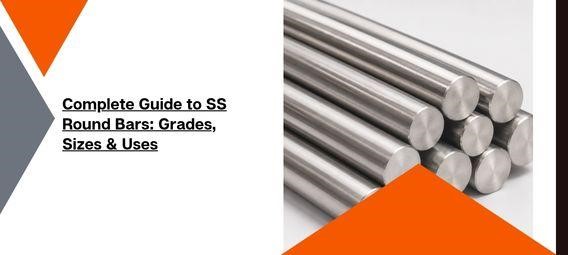
Stainless Steel Round Bars rank among the most widely specified engineering materials across manufacturing, construction, automotive, oil and gas, food processing, marine, and heavy engineering work. Their combination of strength, corrosion resistance, and machinability makes them a practical starting stock for everything from precision shafts to structural fasteners. Selecting the correct grade, size, manufacturing process, and supplier directly shapes how a component performs and how long it lasts in service, and getting any one of those wrong tends to surface as a costly problem well after the material has already been machined or installed.
What Are Stainless Steel Round Bars?
A stainless steel round bar is a solid, cylindrical bar stock produced from a stainless steel alloy, typically formed through hot rolling and then either left as-rolled or further processed through cold drawing, peeling, or grinding depending on the required finish. Industrial Stainless Steel Bars are available across a range of standard finishes to suit different fabrication needs, from rough mill finish to bright, polished surfaces.
The tensile and yield strength of round bars are typically good. They also have good ductility, which maintains their usability for machining and forming. However, the mechanical qualities depend on the grade. Chromium oxide occurs on the surface making it corrosion-resistant, and in higher grades it is supplemented with additional Molybdenum or Nickel. Heat resistance and strength retention at elevated temperatures also vary by grade, which is why grade selection matters so much for demanding applications. Machining characteristics differ too: some grades cut cleanly with standard tooling, while others need slower speeds and sharper tooling to avoid work hardening during the cut.
Stainless Steel Round Bar Grades Explained
Different industries land on different grades because no single grade optimizes for everything at once. Here’s how the common ones stack up.
SS 304 is the general-purpose workhorse of the stainless family, offering solid corrosion resistance and good formability at reasonable cost, covering fabrication, food equipment, and architectural work without needing anything exotic.
SS 304L trades a small amount of strength for lower carbon content, reducing the risk of carbide precipitation during welding, which makes it the better pick for welded assemblies that need to hold up without sensitization issues at the seam.
SS 316 adds molybdenum to the base 304 composition, boosting resistance to chlorides and pitting corrosion. Marine hardware and chemical processing equipment lean on 316 because standard 304 doesn’t hold up as well against saltwater and aggressive chemicals.
SS 316L pairs that same molybdenum-boosted corrosion resistance with the low-carbon advantage of the L-grade, making it a strong choice for welded components in marine or chemical service.
SS 321 is stabilized with titanium, protecting against intergranular corrosion during prolonged exposure to elevated temperatures, which makes it a practical choice for high-temperature equipment and exhaust components under sustained heat cycling.
SS 310 pushes heat resistance further still, holding up in continuous high-temperature service where standard austenitic grades would start to oxidize or lose strength. Furnace components commonly specify 310 for this reason.
SS 410 is a martensitic grade that can be heat treated for higher hardness and wear resistance, at the cost of some corrosion resistance compared to the austenitic grades above, suiting components that need wear resistance more than chemical resistance.
SS 420 takes that hardness potential further, commonly specified for cutlery and surgical instruments, where a sharp, durable edge matters more than broad corrosion resistance.
Duplex grades combine austenitic and ferritic microstructures, delivering considerably higher strength than standard austenitic grades alongside strong resistance to stress corrosion cracking, fitting high-strength structural and offshore applications.
Standard Sizes, Dimensions & Finishes
Round bars come in a wide diameter range, from a few millimeters up to several hundred, supplied in standard mill lengths or cut to custom length on request. Tolerances vary by manufacturing process, with cold-drawn bar generally holding tighter dimensional accuracy than hot-rolled stock.
Surface finish options include bright, black, peeled, ground, polished, and forged, each suited to different downstream uses. Bright and polished finishes suit visible or hygienic applications, black and peeled work fine where dimensional consistency matters more than appearance, and forged bar serves applications needing extra mechanical integrity from the outset. The application ultimately drives size selection: a precision shaft calls for tight-tolerance cold-drawn bar, while structural fabrication can often work from more economical hot-rolled stock.
Common Uses of Stainless Steel Round Bars
Round bar stock is a highly adaptable metal design that is used in all industries of heavy manufacturing to create structural components, turn high-wear machinery parts and provide sturdy frameworks for difficult industrial conditions.
- Automobile Production: machining of heavy-duty drive shafts, engine valves, pumps and high-strength fasteners for car manufacture.
- Marine Engineering: Ensuring propeller shafts and underwater fittings are reliable and resistant to saltwater corrosion.
- Construction and Fabrication: Frames for structural support, bracing rods and specialist metals.
- Hygienic Process Lines: Providing clean, sterile material to specialised food processing, pharmaceutical, and chemical plant equipment.
- Aerospace & Power Generation: Providing ultra-reliable, high-performance alloy parts for mission-critical systems where failure is not an option.
Choosing the Right SS Round Bar
Picking the right round bar comes down to more than grade alone. Shape, manufacturing process, intended application, and supplier capabilities all factor into a decision that holds up once the part is in service.
Stainless Steel Round Bar vs Flat Bar: Which Should You Order?
Round bars and stainless steel flat bar have several structural uses. Round bar is used for shafts, pins and rotating components because it distributes the load evenly across the cross-section, while flat bar is used for applications that require a level mounting surface or a structural framing member. Round stock, for instance, is easily turned on a lathe, whereas flat bar is more easily shaped into brackets and plates. Ease of machining varies, too. Round bars are often employed when rotation, axial stress or a cylindrical ultimate shape is required.
Hot Rolled vs Cold Drawn SS Round Bars: Key Differences
Hot rolled bar is formed at high temperature, keeping production costs down but leaving looser dimensional tolerances and a rougher surface finish. Cold drawn bar goes through additional processing at room temperature, tightening tolerances, improving surface finish, and increasing strength through work hardening, at a higher cost. Precision engineering work generally calls for cold-drawn bar, while heavy structural use can often make do with the more economicalhot-rolledd option.
Top Industries That Use Stainless Steel Round Bars
Automotive, engineering, construction, oil and gas, marine, food processing, chemical processing, power plants, pharmaceutical equipment, and aerospace all draw on stainless round bar regularly. Each industry gravitates toward different grades based on what matters most, whether that’s corrosion resistance, mechanical strength, hygiene standards, or heat performance under sustained operating conditions.
Manufacturer vs Exporter: Which Should You Choose?
| Factor | Manufacturer | Exporter |
| Source of Material | Produces bar directly | Sources from mills or manufacturers |
| Quality Control | Direct oversight of production | Depends on supplier relationships |
| Customization | Often more flexible on custom runs | Limited to what’s available in stock |
| Lead Time | Can vary with production schedule | Often faster for standard stock |
| Traceability | Full production and heat records | Passed through from original source |
A Stainless Steel Round Bar Manufacturer generally offers tighter quality control and more customization flexibility, since production happens in-house rather than through a supply chain. An exporter can still be a reliable source, particularly for standard sizes and faster turnaround, but traceability and customization tend to depend on how closely they work with their own suppliers.
Conclusion
Stainless steel round bars remain a foundational material across manufacturing, construction, and heavy industry because the right grade and finish can be matched to almost any application, from hygienic food equipment to high-strength offshore components. Getting the selection right means weighing grade, size, finish, and manufacturing process against actual operating conditions, not defaulting to whatever’s most familiar. Nandishwar Steel supplies stainless steel round bars across the grades, sizes, and finishes covered in this guide, ready to match the right bar to your project’s requirements.